Brining the Bird
Market Basket’s birds are injected with an 18% solution of salt, water, dextrose, sugar and carrageenan – to get the same texture and juiciness the easiest way to do this is to brine.
In my opinion this step isn’t optional.
This is for 2 whole young chickens – 3-4 lbs each; This is a ~3.5% brine.
- 19 cups of water
- 9 tbsp table salt
- 4.5 tbsp dextrose

This is one of the only times I try to find the birds that are “antibiotic free” etc. type marketing gimmicks.
This has nothing to do with that language and everything to do with the size of the birds. A smaller bird has a bigger skin to meat ratio, are more tender, and smaller birds are what Market Basket is using.
Larger birds of like 5+ lbs aren’t ideal.
Allow to wet brine in your refrigerator in a covered pot for ~16-24 hours.
DO NOT GO LONGER THAN THIS.
If you do, the bird will absorb too much brine and be too salty.
Some Notes on Ingredients Because Brining is Confusing
The Water
To get the water amount, start high with MORE water than you think you need in a large pot – quite literally count the cups.
Then add your bird(s) and start removing cups of water until the bird is just barely submerged.
Doing this prevents you from wasting tons of salt and sugar later.
Remember this # of cups for the next step.
Use My Calculator to Find Salt
The goal of the salt is just to tenderize and absorb moisture – the only difference is the “type” of salt as volume/density matters.
Use my calculator – select 3.5%, input the # cups of water found above, and the type of salt you have and then use the tbsp amount of THAT salt.
Why Dextrose Dylan?
Market Basket and your favorite Rotisserie chickens are using Dextrose. If you don’t have dextrose use white sugar instead.
The reason they’re using Dextrose is:
- It browns faster
The browning/maillard is the goal.
Take the amount of salt you found from my calculator and add half the amount in dextrose.
If you’re using regular white sugar, subtract 1 tbsp from the dextrose amount you found (so I used 4.5 tbsp, this would be 3.5 tbsp) as dextrose is 20% less sweet.
Air Drying the Next Day
Take the bird out of the brine and rinse in the sink. Pat dry with paper towel.
Set on a wire rack on a plate or small baking sheet for ~2-4 hours OR ideally overnight.
This dries the skin out and promotes browning later – liquid will also purge in the pan, discard this.

Make their Rub…But Some Quick Comments
They’re using a Commercial rub – from the Ingredients list and confirming online, it’s Mr. Pig’s BBQ Spice Mix.
BUT Everson Spice has a video going over the flavor profile – Cody states…”Savory notes of Onion, Garlic, Black pepper, smoked paprika, also drives a really nice sweet flavor from brown sugar that’s added into the blend.
BUT random nutrition facts don’t show a significant amount of carbohydrates in their rub (aka where brown sugar would show up) by US law they are required to list sugar too and sugar specifically can’t hide behind “spices.” We also have the label above which shows no sugar.
With that said – these Roasters have a significant amount of caked on “crust” and that is almost certainly paprika. So the blend they’re using is likely a Custom Mr. Pig’s blend in some capacity as the roasters do not have Sugar.
With all that said – this is my best guess:
- 3.5 tsp table salt
- 1 tablespoon smoked paprika
- 1/4 teaspoon garlic powder
- 1/4 teaspoon onion powder
- 1/8 teaspoon table ground black pepper
- 1/8 teaspoon MSG*
- 1/4 teaspoon cornstarch
Then apply a super thin layer of oil and then ~1-2 tsp of rub to both sides of the bird – 2-4 tsp total – you’ll likely have rub leftover.

Mix the above in advance and you’ll notice the paprika color (redness) will leach into the salt and change its color; This is why they use Oleoresin – it’s just for color.
They’re also using a few carriers like Maltodextrin and Silicon Dioxide – both just help to prevent clumping; The best way to replicate this at home is 1/4 tsp cornstarch or just omit.
*I use MSG because they’re using Hydrolyzed soy protein. Which is essentially an MSG substitute without the stigma that’s associated with MSG.
BBQ rubs do the same thing with “Yeast Extract.”
If you don’t want to use it – don’t.
Get Your Rotisserie Setup
Use some Butcher’s twine to truss the bird.
Then put the meat on the Rotisserie.

I’m using my Monument Gas grill which has an infrared back burner – aside from that I also turned the 1st and last burner on to medium heat so the ambient temperature was ~325-350F.
Check Breast Meat After ~45 Minutes
Stop the rotisserie from spinning and use an instant read thermometer to probe the breast meat. Our goal is to be at around 155-160F in the breast before pulling them off the rotisserie.
Via carry over cooking it will be safe to eat and be more juicy than if you went to 165F then rested.

Granted, sometimes Market Basket’s chicken is slightly dry due to sitting on the warmer but their turnover is so high where I live that this almost never happens.
Since you brined too, there’s less susceptibility to drying out and you can push to ~170F without turning the breast into sawdust.
If the chicken isn’t done, put back on to spin for ~15 more minutes and repeat checking every 15 minutes until done.
My chickens hit 162F in 1 hr and 30 minutes.
Then take off to rest for ~5-10 minutes.
Slice and enjoy.
(Do we now see why it’s cheaper just to buy the chicken – the bird alone was ~$10).
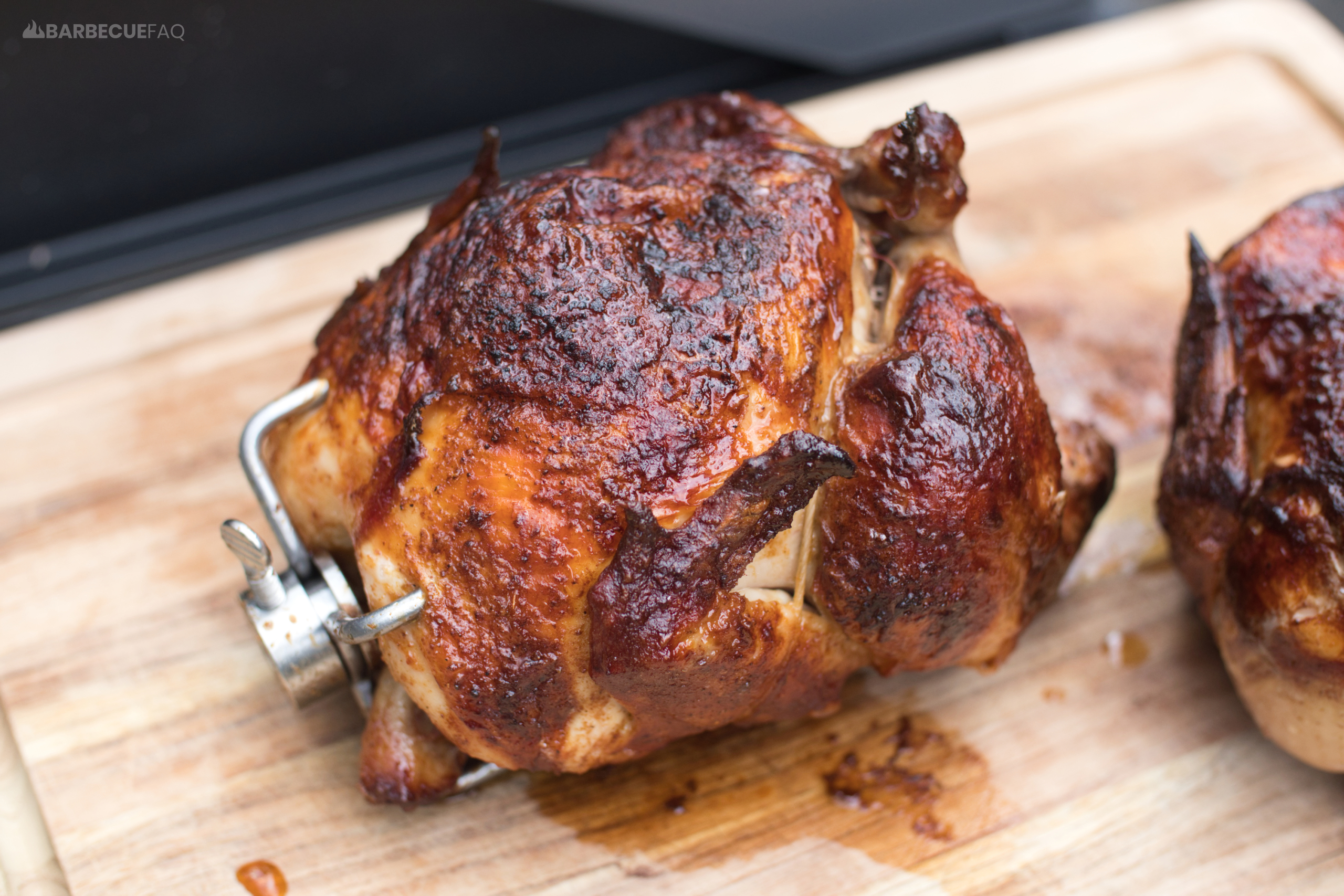
Market Basket Rotisserie Chicken Copycat
Ingredients
Brine (for 2 birds)
- 19 cups water
- 9 tbsp table salt
- 4.5 tbsp dextrose
Market Basket's Rotisserie Chicken Rub
- 3.5 tsp table salt
- 1 tablespoon smoked paprika
- 1/4 teaspoon garlic powder
- 1/4 teaspoon onion powder
- 1/8 teaspoon table ground black pepper
- 1/8 teaspoon MSG*
- 1/4 teaspoon cornstarch
Oil for Binder
- 1/2 tsp Vegetable oil per side of bird
Instructions
- Combine 19 cups water, 9 tbsp table salt, and 4.5 tbsp dextrose in a large pot.Note: This is based on using 2 birds – if you only have 1 bird, use my calculator to determine your water, salt, and sugar.
- Submerge 2 whole young chickens (~3-4 lbs each) in brine.
- Cover and refrigerate for 16-24 hours – do not go longer than 24 hours.
- The next day, remove chickens from brine and rinse in the sink.
- Pat dry with paper towels.
- Place on wire rack over plate or baking sheet and air dry for 2-4 hours or overnight on the bottom shelf of your refrigerator.
- Make rub. The main "stuff" are the smoked paprika, salt, onion + garlic powder, and black pepper. If you don't want to use MSG, don't. Same with cornstarch (used to avoid clumping).3.5 tsp table salt, 1 tablespoon smoked paprika, 1/4 teaspoon garlic powder, 1/4 teaspoon onion powder, 1/8 teaspoon table ground black pepper, 1/8 teaspoon MSG*, 1/4 teaspoon cornstarch
- 2-4 hours later or the next day, truss chickens with butcher's twine.
- Apply a thin layer of neutral oil to both chickens as binder.
- Apply 1-2 tsp rub to each side of both birds (I start back side first).
- Place on rotisserie and set grill to 325-350F with infrared back burner and first and last burners on medium.Note: This will be different based on your setup. This is how I did it on my Monument gas grill.
- Check breast temperature after 45 minutes with instant read thermometer.
- Target 155-160F in breast meat.
- If not done, return to rotisserie and check every 15 minutes until target temperature reached.
- Remove from rotisserie and rest for 5-10 minutes.
- Slice and serve.
Notes
Quick Comments for the Food Nerds like me – In terms of taste, I’d change nothing.
The brine is solid, perfect salt level for me and my family. The rub is about as close as you’re going to get to what they’re using.
My paprika is also Burlap and Barrel’s Smoked paprika.
The biggest difference between my recipe and Market Basket’s is really just the size of the birds – smaller birds will have smaller joints – so the drums and the thighs will push into 200F easily (meaning more fall of the bone), same with the wings before your breast hits doneness.
My drums were around ~185-188F, same with the thighs. I prefer both of these to be 200F+.
My birds were 3.73 lbs in the packaging; After removing the giblets and brining they weighed 3.54 lbs. Market Basket is using birds even smaller than this.